Model routers
Serve models to any harness through OpenRouter, with a per-model policy for who may launch them.
A model router supplies models independently of the agent harness. The harness still runs the agent loop; the router changes where its model calls go. Claude Code speaks the Anthropic Messages protocol and Codex speaks the OpenAI Responses protocol, and a router that serves both can sit behind either one. OpenRouter is the router that ships, and it serves both.
Connect OpenRouter
Section titled “Connect OpenRouter”You need one thing from OpenRouter: an API key. There is no OAuth application, no callback URL, and no webhook.
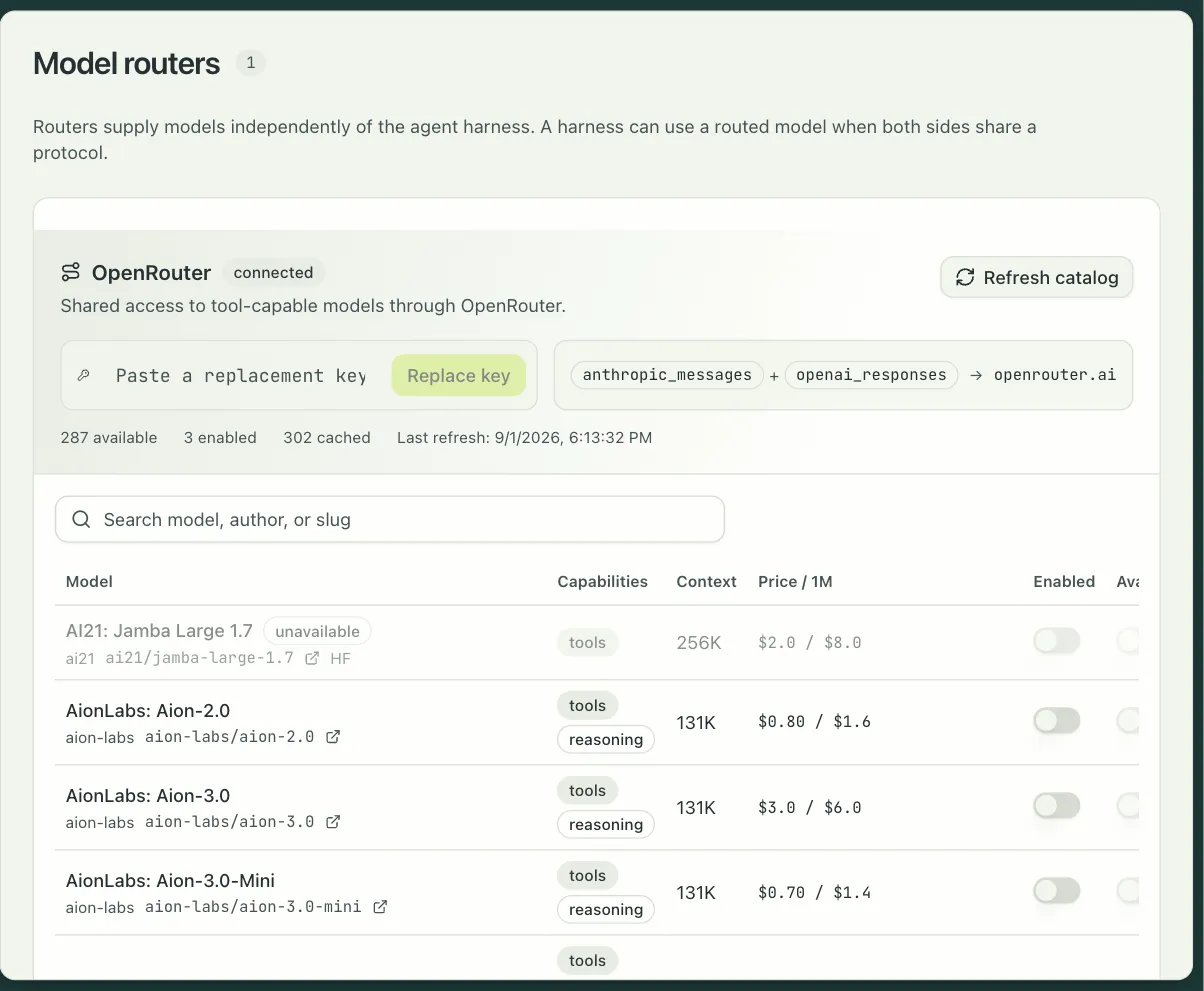
- Open Settings → Model routers. The OpenRouter card says “key required” until a key is saved, and until then the router is invisible everywhere else: no Route option in the task composer or the profile editor, and no catalog refresh.
- Paste the key and select Save key. It is stored as the org secret
openrouter.api_key, sealed like every other org secret. - Select Refresh catalog. engrams fetches OpenRouter’s model list, keeps the models that produce text and support tools, and drops the rest. The catalog refreshes on its own every six hours after that; if a refresh fails, the card shows the error and the last good catalog stays in use.
Decide who may launch what
Section titled “Decide who may launch what”A fresh catalog is inert: every model arrives disabled. Each row has two switches.
| Switch | Who it opens the model to |
|---|---|
| Enabled | Programmatic runs: Slack, schedules, webhooks, the API. |
| Available to users | People, in the task composer’s model picker. Requires Enabled. |
The table shows each model’s capabilities, context window, and price per million tokens, with a search box over name, author, and slug, and a link to the model’s page on OpenRouter. A model that OpenRouter has withdrawn stays in the table marked unavailable so you can see what changed, and cannot be launched.
Use a routed model
Section titled “Use a routed model”In the task composer and in a profile, the Route control offers the native provider and every connected router whose protocols overlap the selected harness. Pick OpenRouter and the model list becomes the routed catalog. A profile’s route is its default; a task can override it. Switching to a harness that cannot speak the router’s protocol clears the route.
Three things change on a routed launch, and all of them are enforced before the session boots.
- Egress. The session may reach
openrouter.aiand may not reach the provider’s own API hosts. A routed Claude Code session cannot call Anthropic directly, and a routed Codex session cannot reach OpenAI or ChatGPT. - Credentials. The router key is brokered at the egress proxy for
openrouter.aiand is never in the VM’s environment. The person’s own Claude Code token or ChatGPT connection is not injected, so someone with no provider credential of their own can still start a routed session. The organization’sANTHROPIC_API_KEYorCODEX_API_KEYis not injected either. - Effort. If the model does not advertise reasoning support, the effort setting is dropped rather than sent.
A launch is refused, with the reason, when the harness has no adapter for the router’s protocol, the model is unavailable, the model is not enabled for the caller, or the key is missing.
What routes today
Section titled “What routes today”OpenRouter is the only router, and the router list is part of the release, not something an admin can extend. Adding a second router means a change to engrams.